
About
The Ilan Genre
Kabbalistic ilanot are diagrams in which texts and images together map the divine realm. Their name—the plural of the Hebrew ilan, “tree”—comes from the branching structure commonly used to represent the ten sefirot: the divine powers through which God creates and sustains the world.
The genre emerged in the fourteenth century, when kabbalists began drawing these diagrams on large parchment sheets. They called the resulting works ilanot (“trees”) or yeriʿot (“parchments”), names that refer respectively to their characteristic form and their material. Over the following centuries, ilanot developed into an extraordinarily varied genre, ranging from relatively spare trees to densely inscribed scrolls several meters long.
Mapping the divine realm
For kabbalists, the sefirot provide keys to understanding scripture, creation, and human life. Qualities such as wisdom, love, judgment, and compassion belong to an interconnected divine order. An ilan makes that order visible, but different compositions organize its teachings in different ways.
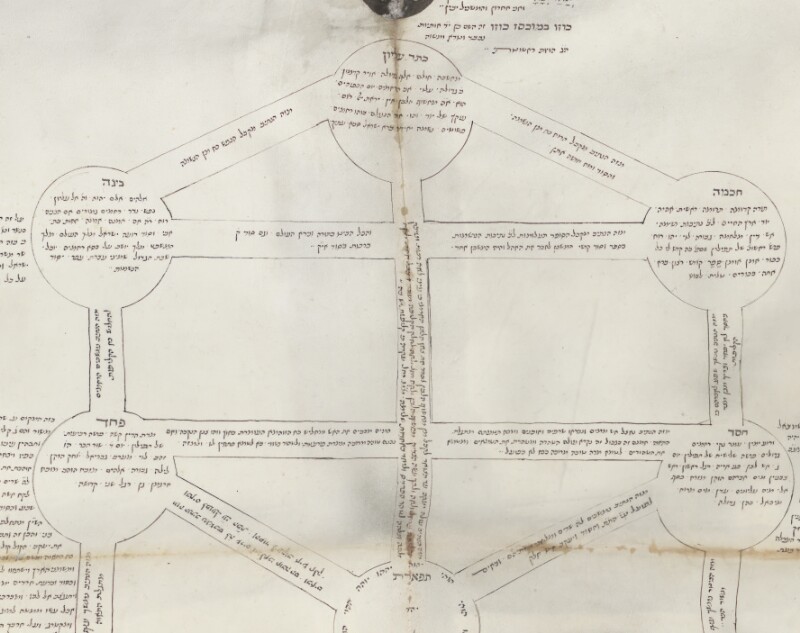
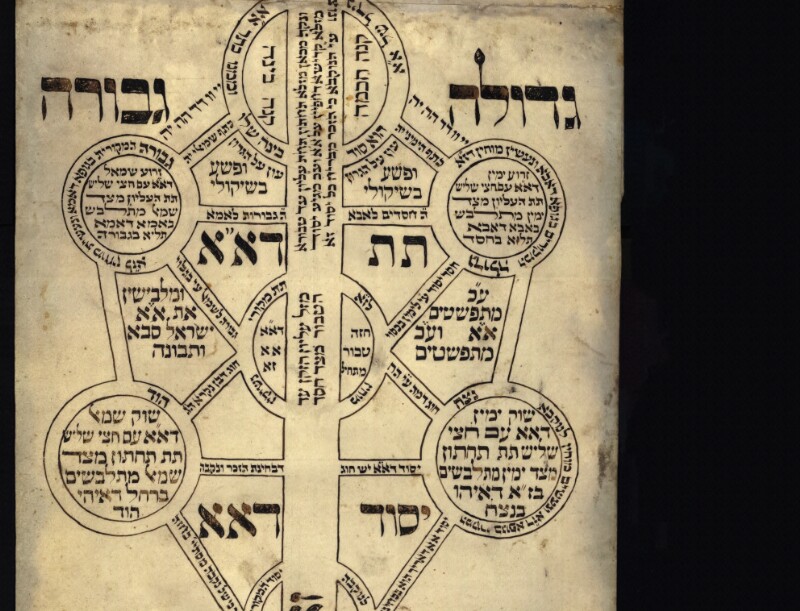
Munich, Bavarian State Library, Cod.hebr. 448. Names and appellations occupy the circles; explanations also run along the channels and beside the tree. The sheet measures 49 × 38 cm. Explore this ilan ↗
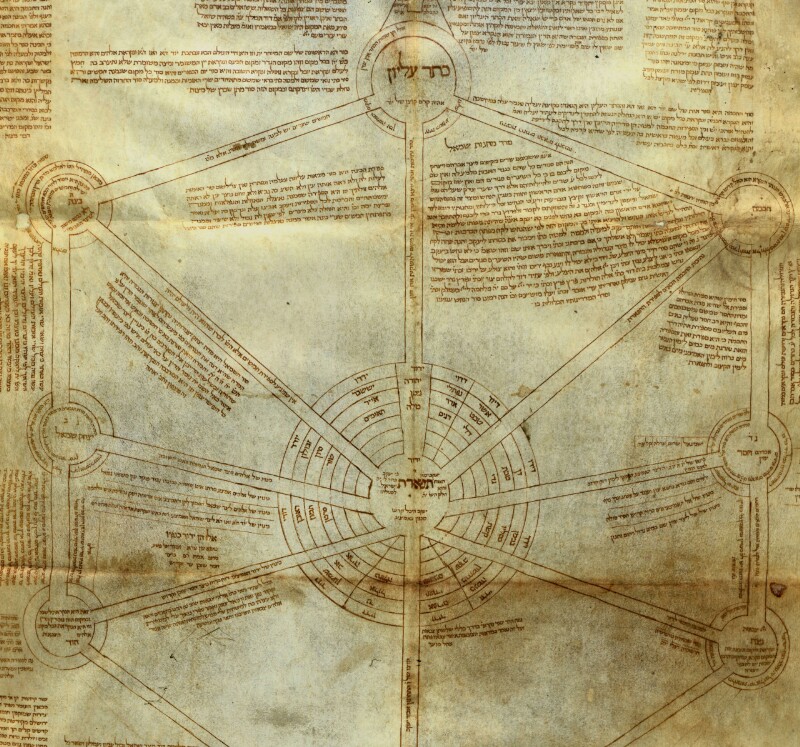
Brescia, Biblioteca Queriniana, MS L FI 11. This late-fourteenth-century parchment transmits a text attributed to Joseph Gikatilla. Notice the central wheel, radiating channels, and substantial passages between the branches. The parchment measures 76 × 56 cm. Explore this ilan ↗
In the Small Parchment type, each sefirah is represented by a medallion containing names and associated expressions. The connecting channels carry explanations of their own. In the Brescia ilan, associated with Gikatilla’s teaching, extended discussions surround the diagram, while a wheel gives particular prominence to Tiferet (“Beauty”). Both are classical ilanot, but their arrangements direct attention differently.
Reading words and images together
An ilan combines words and images so closely that they must be read together. A name inside a circle, a passage along a channel, and a commentary beside the tree acquire meaning partly through their placement.
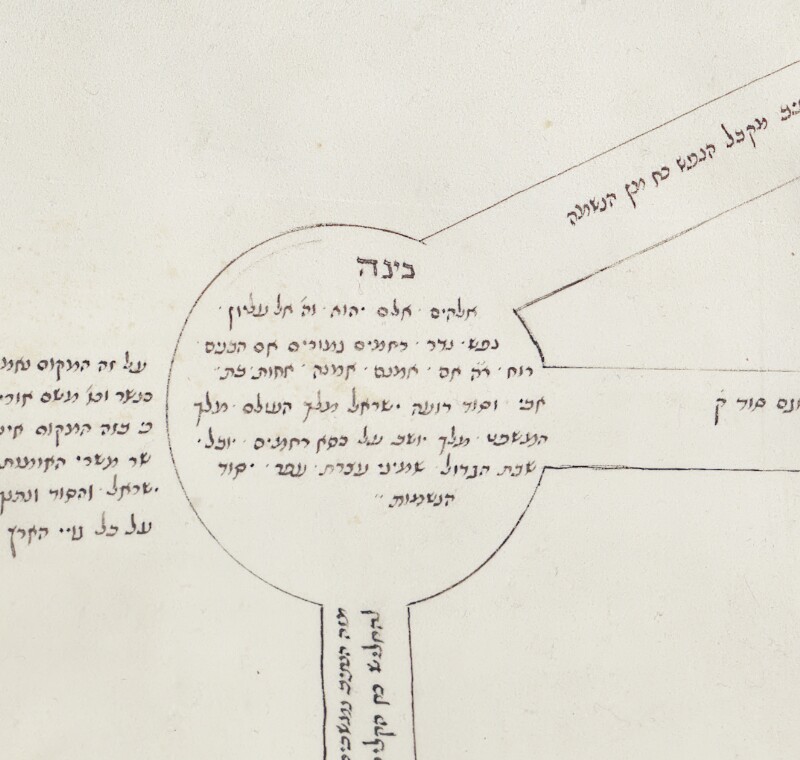
Binah (“Understanding”), in the Munich Small Parchment. Its principal name appears above a cluster of associated terms. The circle gathers them into one place. Explore this ilan ↗
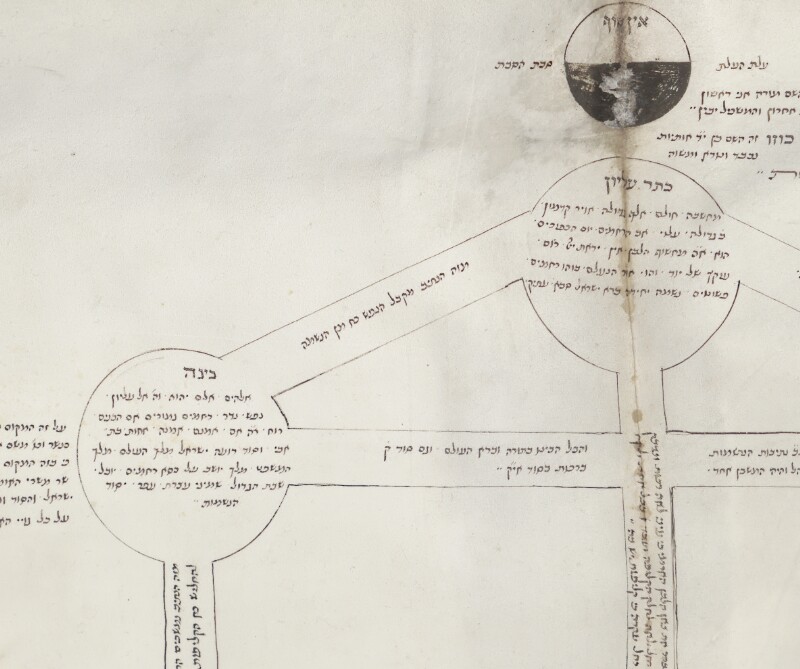
The upper part of the same tree. Follow the diagonal connection between Keter (“Crown”) and Binah. The words run with the channel; their placement ties the teaching to the relationship drawn here. Explore this ilan ↗
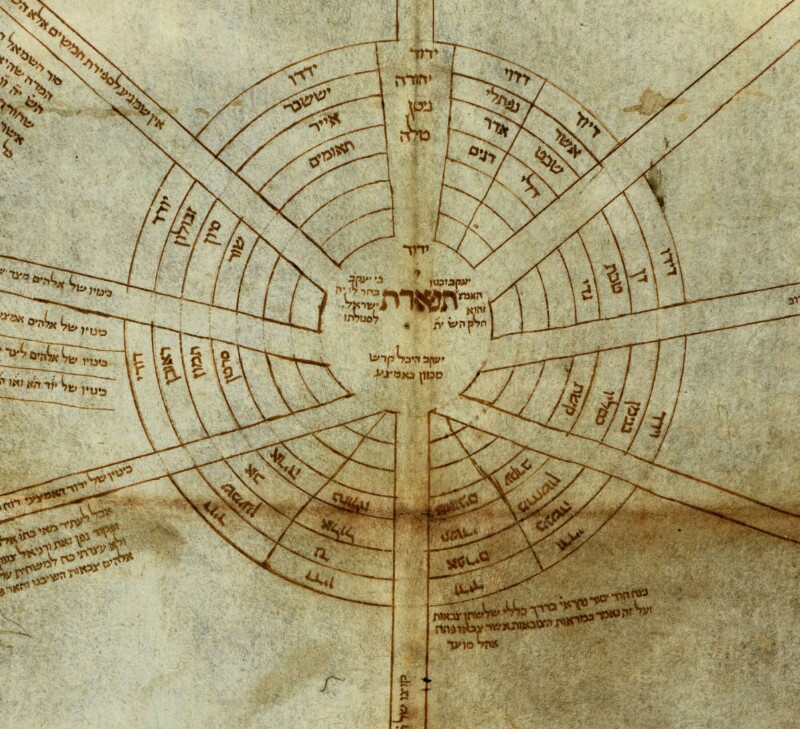
Around Tiferet, concentric bands coordinate sets of twelve: zodiac signs, Hebrew months, the tribes of Israel, and arrangements of the letters of the divine name. The diagram relates the divine order to time and the cosmos. Explore this ilan ↗
Reading involves movement between the overall arrangement and its details. The eye follows a channel, pauses over a cluster of names, and returns to the larger structure. Large parchment sheets make many relationships available at once; long scrolls disclose successive portions as they are unrolled. The material form shapes the encounter with the teaching.
Study, prayer, and contemplation
Ilanot helped students learn, teachers explain, and experienced kabbalists retain complex bodies of knowledge. Study could also prepare the mind for contemplation and visionary experience.
These purposes were closely connected to religious practice. Kabbalists accompanied prayer with kavvanot (“intentions”), directing their thoughts toward particular sefirot and their relationships. An ilan could help them learn the configuration they sought to hold in mind.
Such attention was understood to have consequences. Human action, including prayer and thought, could contribute to tiqqun: the repair and enhancement of divine harmony. An ilan could thus serve as an instrument of devotional work as well as a guide to knowledge. Some were also used as amulets, credited with protective power.
From trees to unfolding worlds
The teachings associated with Isaac Luria (1534–1572) gave kabbalists a substantially more elaborate account of the divine realm. Lurianic ilanot developed ways to represent its emergence and transformation: the formation of worlds and divine figures, their interactions, and processes of shattering and repair.
Trees remained fundamental, but were joined by intricate arrays of circles, human forms, and tables. Repeated structures could show successive stages or different perspectives.
These four examples trace a path from separate Lurianic diagrams to a composite scroll. Each image is a detail; select it to examine the work in its site edition.
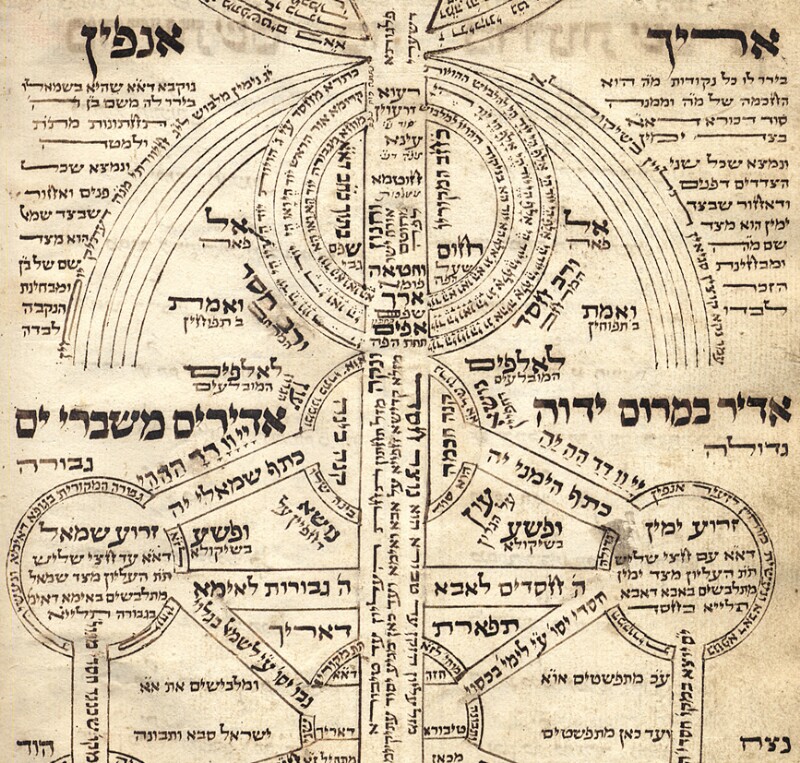
A detail from Zacuto’s diagram in Warsaw, Jewish Historical Institute, Ms. 293. The older tree form is put to work representing the Lurianic divine figure Arikh Anpin. Explore the edition ↗
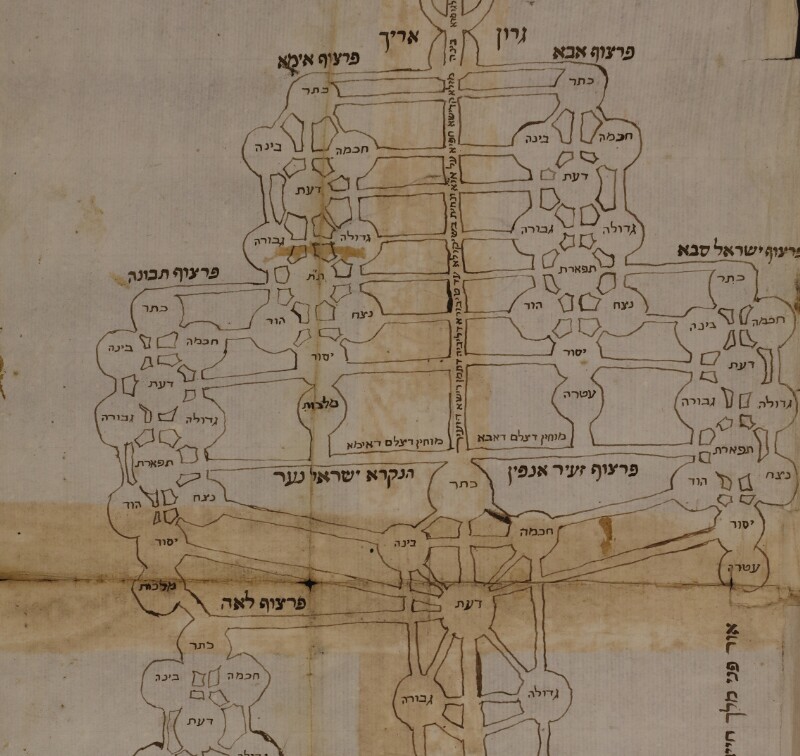
A detail from Moscow, Russian State Library, Ms. Guenzburg 53. Interconnected trees help visualize hitlabshuyot (“enrobings”): relationships in which one divine configuration is clothed within another. Explore the edition ↗
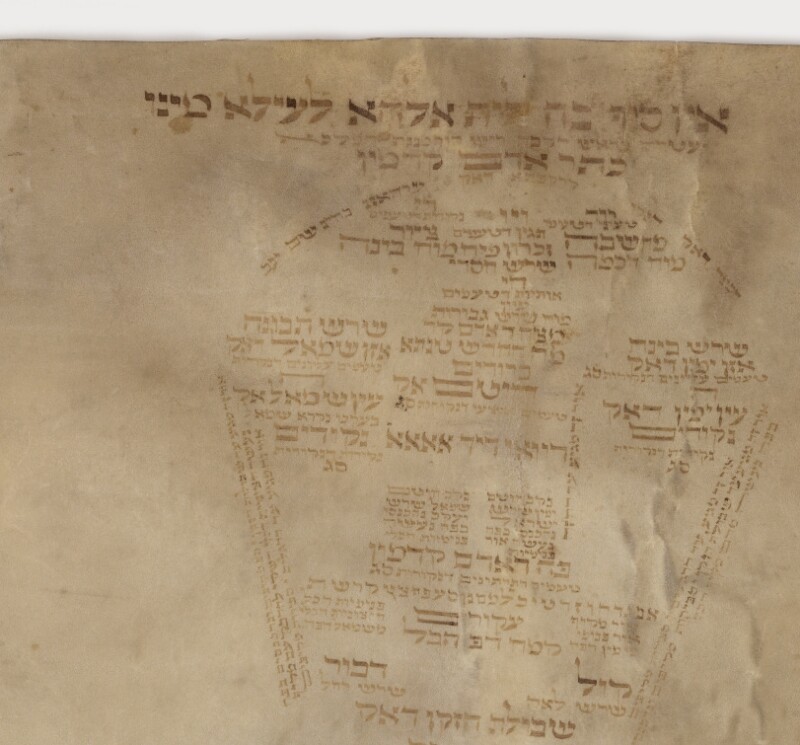
At the top of this scroll (Jerusalem, National Library of Israel, Ms. Heb. 4°9795), the names and structures of Adam Kadmon (“Primordial Human”) form a schematic head. The scroll continues with its enrobings. Explore the edition ↗
A detail from Isaac Grupa’s scroll, Cincinnati, Hebrew Union College, Klau Library, Scrolls 69. This composite joins Poppers’ and Zacuto–Ẓemaḥ’s material with a further component derived from Knorr. Explore the edition ↗ Read What is a Great Tree? ↗
The editions on this platform connect such images with transcriptions, translations, sources, and explanations, allowing readers to move between the visible marks and the knowledge they convey.