
Research
Lurianic Cosmogony: What You Need to Know
~ J. H. Chajes
The trees, circles, heads, and names in a Lurianic ilan belong to a detailed account of how the divine realm unfolds and how its parts relate to one another. This account is its cosmogony: its explanation of the emergence and ordering of reality. “Lurianic” refers to the teachings associated with R. Isaac Luria (1534–1572), transmitted and developed by his disciples.
An ilan is a “tree”; ilanot is the plural. These diagrams give readers a way to follow relationships that can be difficult to grasp in prose. The guide below introduces the principal terms in the sequence visualized by Jacob Ẓemaḥ and Meir Poppers. Select an illustration to open its annotated detail; the feature links let you compare examples across manuscripts.
Begin with the sefirot
The sefirot (singular: sefirah) are the ten divine powers or attributes through which the Divine becomes manifest. Their names include Ḥokhmah (Wisdom), Binah (Understanding), and Malkhut (Kingdom). On an ilan, they often appear as named circles connected by lines or channels. Texts and divine names written within a circle explain the power represented there.
A sefirah can itself contain a complete tenfold structure. This helps explain why an ilan may repeat the same names at several levels, or show a small tree within a larger one. When following a label, ask both “Which sefirah is this?” and “Of which larger structure is it a part?”
1. From the Infinite to Adam Kadmon
Ein Sof — “No End,” or the Infinite. This is the unlimited divine source. It surrounds all the Worlds and remains present within them, though increasingly concealed. The language of divine “light” describes this presence and its transmission. See how manuscripts mark Ein Sof.
Ẓimẓum — contraction or self-evacuation. In the account summarized here, Ein Sof clears a sphere for emanation. The resulting space is called the ḥalal ha-panui (“vacant space” or “vacant sphere”), also known as the Tehiru. Emanation is the unfolding of differentiated divine powers from their source.
‘Iggulim and yosher — circles and the upright arrangement. Sefirotic spheres are emanated into the vacant space, followed by an arrangement organized on the pattern of a human body. The latter is called Adam Kadmon, the “Primordial Human,” often abbreviated AK. It has the tenfold structure of a sefirotic tree. These terms help you recognize two visual languages used in Lurianic diagrams: concentric circles and an arrangement with a head, a central axis, and differentiated sides.
The two details below show how differently manuscripts can present Adam Kadmon. Explore all the platform’s Adam Kadmon examples.
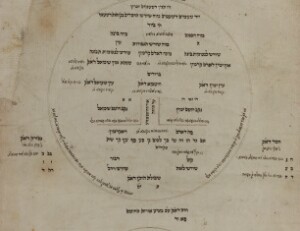
Look at the outline and the arrangement of inscriptions within it. The human form provides an organizing framework for the divine structure. Jerusalem, National Library of Israel, Ms. Heb. 8°963.
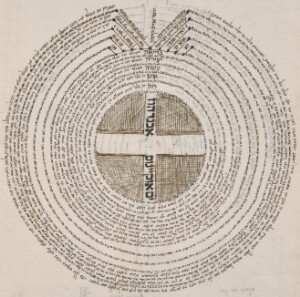
Here the annotated circle belongs to a diagram of concentric circles. Look for the repeated rings and the axis running through their center. New York, Jewish Theological Seminary, Ms. 2187, fol. 64v.
2. Ten sefirot, five divine personas
Most Lurianic ilanot concentrate on Aẓilut, the World of Emanation. A “World” is an ordered level of reality. Aẓilut is the highest of the Four Worlds and is located within the Malkhut (Kingdom) of Adam Kadmon.
Within Aẓilut, the ten sefirot are organized into five principal divine personas, called parẓufim (singular: parẓuf). Although parẓuf is often translated literally as “face,” it designates a whole divine body, with a head, limbs, and internal divisions. Its structure can be drawn as a tree or expressed through circles, names, and tables.
The following correspondences let you move between the two sets of names:
| Divine persona | Meaning of the name | Corresponding sefirah or sefirot of Aẓilut |
|---|---|---|
| Arikh Anpin | Long-Faced One; Patient One | Keter — Crown |
| Abba | Father | Ḥokhmah — Wisdom |
| Imma | Mother | Binah — Understanding |
| Ze‘ir Anpin | Short-Faced One; Impatient One | Ḥesed — Love; Gevurah — Strength; Tiferet — Beauty; Neẓaḥ — Endurance; Hod — Splendor; Yesod — Foundation |
| Nukba de-Ze‘ir | Female of Ze‘ir | Malkhut — Kingdom |
The arithmetic is useful: 1 + 1 + 1 + 6 + 1 = 10. Ze‘ir Anpin corresponds to six sefirot, while each of the other four personas corresponds to one. Each persona also has its own internal sefirotic structure—one reason the same names recur throughout a diagram.
The family language describes relationships. Abba and Imma are a productive pair whose union and nurturing sustain Ze‘ir Anpin. His connection with his female counterpart, Nukba, can be disrupted by human sin. Restoring that connection is a central concern of Lurianic religious practice. The relations charted on the scroll therefore concern the effects of human conduct as well as the organization of the divine realm.
Find the five personas in a manuscript. The following details all come from the Ilan of Expanded Names in Oxford, Bodleian Libraries, Ms. Opp. 458, fol. 321r. They show how names and shapes distinguish the personas on a single sheet. Select any detail to explore its position in the whole diagram.
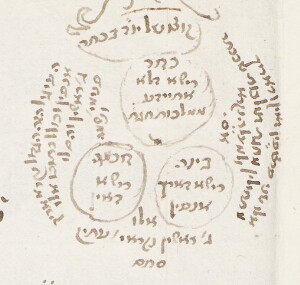
The upper circles name Keter, Ḥokhmah, and Binah within this persona. A whole persona can thus correspond to one sefirah of Aẓilut while containing its own internal sefirot.
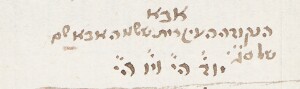
Look for the short label naming Father above a group of divine names. Open the detail to locate it beside Mother on the complete sheet.
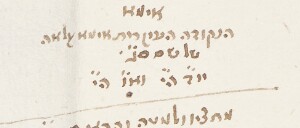
The label at the top identifies Mother. The divine names below it are part of this manuscript’s way of specifying the contents of each persona.
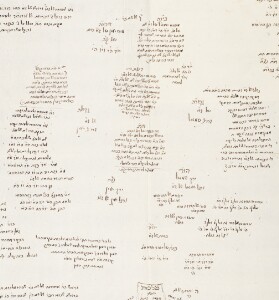
Follow the tall arrangement through its successive levels. In the complete sheet, compare its position with the rounded figure of Nukba below.
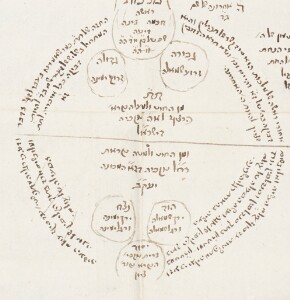
Notice the circles and subdivisions inside the enclosing outline. Here, too, the persona has an internal structure, even though it corresponds to the single sefirah Malkhut of Aẓilut.
3. What does “enrobing” mean?
Hitlabshut, or enrobing, is the process by which one divine configuration becomes clothed within another. A lower persona acts as a garment around part of a higher one. What was on the outside of the higher persona becomes concealed inside the lower. The higher configuration remains present and active within the lower one.
For example, the lower parts of Abba and Imma are enrobed in Ze‘ir Anpin, sustaining its growth. Nukba, in turn, enrobes the seven lower sefirot of Ze‘ir. Through successive enrobings, the light of Ein Sof reaches down through the divine realm, concealed beneath many layers.
This helps explain the distinctive layout of many Lurianic ilanot. The heads of the personas begin at different levels, but their feet reach together to the base of Aẓilut. Beneath their exposed heads, their bodies are clothed within one another. Lines, trees of different sizes, and tables help readers trace these connections. A persona may be described as a complete body with 248 limbs and 365 sinews even where most of that body is hidden.
Try following an enrobing diagram. In the Zacuto–Ẓemaḥ ilan below, begin with the large tree in the upper part, which presents Arikh Anpin. Then zoom into the smaller trees below and follow the channels between them. Both sections show Aẓilut from different perspectives: the lower section brings the relationships among its personas into view. The elongated tree near the center of that section represents Ze‘ir Anpin. Open the complete diagram in its own viewer.
Names you may encounter near the top: ‘Atik and ‘Atik Yomin. The Malkhut of Adam Kadmon itself contains a complete tenfold structure. Its upper three sefirot are called ‘Atik (“Ancient One”), or “head”; its lower seven are ‘Atik Yomin (“Ancient of Days”), or “body.” The inner dimension of this body is called Reisha de-lo ityada, “the head that is not known.” Arikh Anpin enrobes ‘Atik Yomin as its soul. Locate these names in a Poppers ilan.
4. From Aẓilut to the lower Worlds
The Four Worlds, in descending order, are:
- Aẓilut — Emanation
- Beriah — Creation
- Yeẓirah — Formation
- ‘Assiah — Action
At the base of Aẓilut, divine light “thickens” to form a masakh, a veil. This marks the threshold to the next World. The seven lower sefirot of the Malkhut of Aẓilut cross that threshold and become the ten sefirot of Beriah. Enrobings unfold there and in the Worlds below it. The tree, its tenfold structure, and the relations among personas recur at successive levels.
These two details come from a Great Tree in Jerusalem, National Library of Israel, Ms. Heb. 4°9791. In the complete scroll, Beriah appears above Yeẓirah.
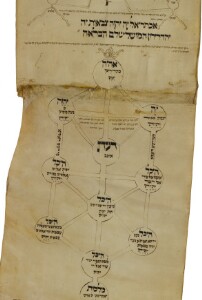
A new sefirotic tree organizes this World. Look for the repeated arrangement of named circles, then open the detail to see its position below Aẓilut.
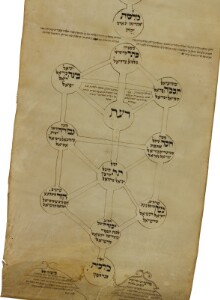
Another tree follows further down the same scroll. Compare its structure with the World of Creation above it. The repeated pattern helps readers move between Worlds.
Putting the guide to work
When you open an ilan, first locate the World or major configuration you are looking at. Then identify the persona, and follow the names of its internal sefirot and the connections leading to other figures. A label such as Malkhut becomes much more informative once you know whose Malkhut it is.
For further examples, explore the platform’s parẓufim, Poppers ilanot, and the introduction to Great Trees.
Source and further reading
J. H. Chajes, The Kabbalistic Tree (University Park, PA: Penn State University Press, 2022), 124–125, “Lurianic Cosmogony: What You Need to Know.” For the sefirot and the language of the tree, see 1–3, 7–8; for bodies, trees, and enrobing in the Zacuto–Ẓemaḥ ilan, see 132–134.
The outline on pages 124–125 adapts Ḥayyim Vital’s Seder ha-aẓilut be-kiẓur muflag (“Order of Emanation in Exaggerated Brevity”), a short account adopted by Ẓemaḥ and Poppers. It provides a guide to the diagrams discussed here; individual Lurianic works develop the sequence in different ways.