
מחקר
What Is a “Great Tree”? (אילן גדול)
~ J. H. Chajes
A Great Tree (ilan gadol, אילן גדול) is a composite Lurianic ilan: a scroll assembled from diagrams with distinct histories. Its defining feature is its construction from multiple components. Some of these once circulated as independent ilanot. When incorporated into a Great Tree, they became modules in a more extensive visualization of the divine realm.
By the second half of the seventeenth century, kabbalists had several ambitious visualizations of Lurianic teachings at their disposal. They combined these resources by placing one after another or by integrating parts of one into another. The resulting scrolls could be expanded, abridged, rearranged, and embellished. “Great Tree” is my designation for these compound artifacts, drawing on terminology used by their makers. Forms of the Poppers and Zacuto-Ẓemaḥ ilanot constitute their characteristic core, although a few exceptional combinations are known. (The Kabbalistic Tree, 201–209; 390, n. 4.)
Reading the Composite Scroll
The diagram below identifies four successive components in a Great Tree now in the National Library of Israel, Ms. Heb. 4°9791 (formerly GFCT 028.012.012). Reading from top to bottom, its structure is K–P–Z–Wy.
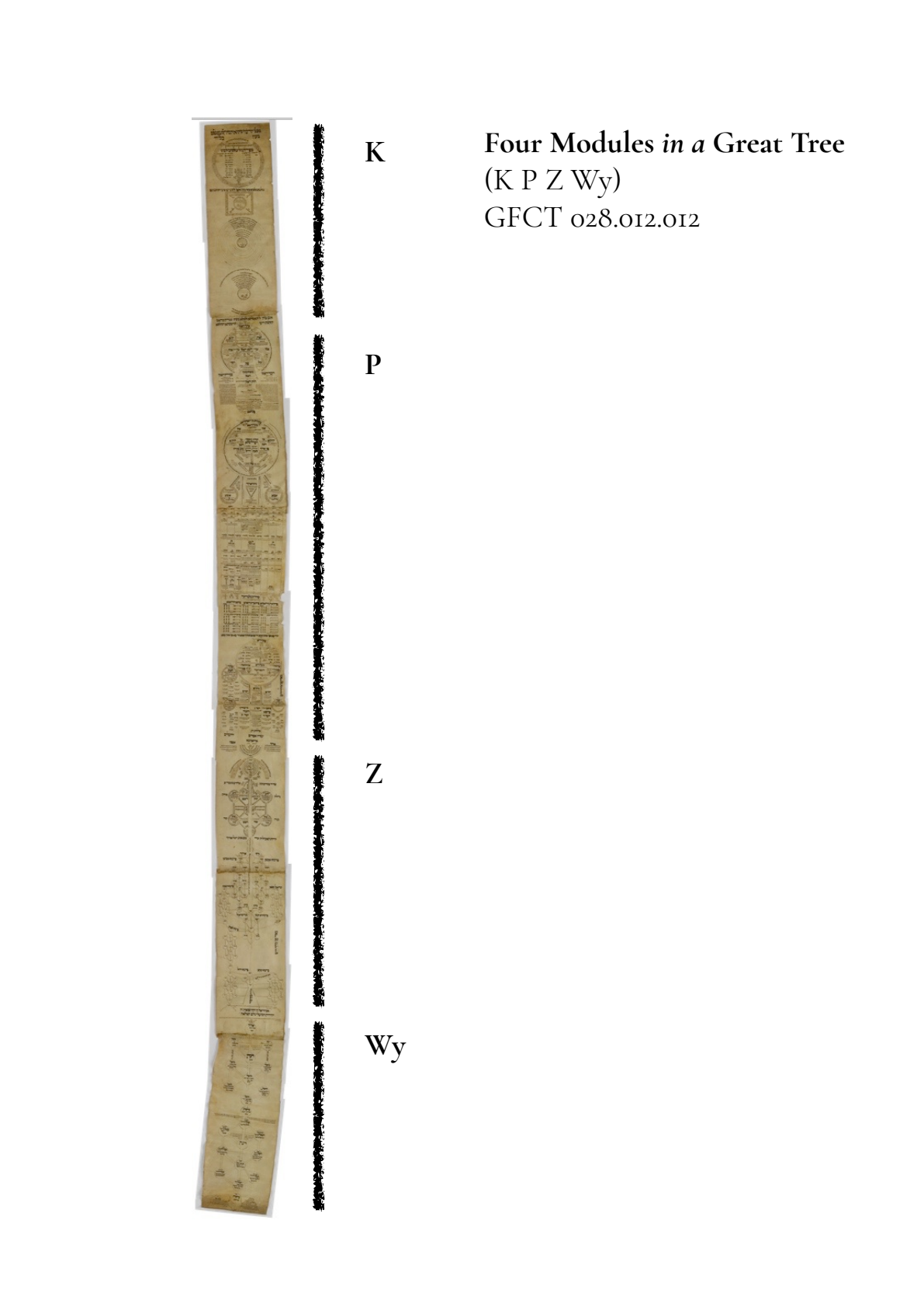
K — A primordial prologue. Knorr’s Saruqian diagrams visualize the Malbush, the divine Garment, and other stages preceding the beginning of the Poppers ilan.
P — Adam Kadmon and the Enrobings. The Poppers ilan begins with the head of Adam Kadmon and follows its enrobings within the divine configurations, the parẓufim.
Z — Arikh and the Enrobings. The Zacuto-Ẓemaḥ ilan presents another visualization of much of the same divine structure. The scroll therefore returns to cosmological territory that P has already traversed.
Wy — The lower Worlds. This supplementary element extends the presentation below Aẓilut, the World of Emanation. In this version, the sequence ends with Yeẓirah, the World of Formation. Other versions of W continue through ‘Assiah, the World of Action.
The letters identify components; they do not imply that every Great Tree contains this particular sequence. Nor do all four components have the same history. P and Z circulated as independent ilanot, while the lower-Worlds diagrams are classified in my key as supplementary elements. The illustrated scroll is discussed on p. 221 of The Kabbalistic Tree; the components key appears on p. 208. Explore the complete manuscript.
Before They Became Modules
P — The Poppers Ilan
Meir Poppers’ ilan combines a visualization of the head of Adam Kadmon with a detailed account of the enrobing process. In this process, the outer dimensions of a higher parẓuf become the inner dimensions of a lower one. Poppers gave these relationships a densely articulated graphical form. The independent witnesses preserve a complete work in its own right; “P” describes the role this work subsequently assumed within composite scrolls. The National Library of Israel’s Ms. Heb. 4°9795, shown below, preserves such an independent witness. (The Kabbalistic Tree, 135–144.)
Browse the independent Poppers ilanot, or read The Poppers Ilan: A Visual History.
Z — The Zacuto-Ẓemaḥ Ilan
Z joins Moses Zacuto’s diagram of Arikh Anpin to Jacob Ẓemaḥ’s visualization of the enrobings. Its two parts correspond to figures 13 and 14 in Christian Knorr von Rosenroth’s Kabbala Denudata, hence the designations Z13 and Z14. The upper part maps Arikh Anpin; the lower part shows how the divine configurations interlock, using trees of different sizes and channels connecting their constituent sefirot.
Z itself thus has a composite history. Nevertheless, its early and enduring combination circulated as an independent ilan before being incorporated into Great Trees. “Independent” describes the artifact’s circulation and use, rather than attributing every part of it to one author. Munich, Bayerische Staatsbibliothek, Cod.hebr. 449 is a seventeenth-century witness to this joined form. (The Kabbalistic Tree, 129–135.)
N — The Ilan of Expanded Names
The Ilan of Expanded Names offers a different approach to Lurianic visualization. Within its circles and subdivisions, divine names, their expanded spellings (miluim), and their numerical values are correlated with the parẓufim. Its characteristic form presents a synoptic view of the divine structure, in contrast to the more sequential presentation of enrobings in P and Z. It, too, circulated independently and was incorporated into some Great Trees. In Kabbala Denudata, it appears as figure 15. (The Kabbalistic Tree, 152–161.)
The example below is Israel ben Asher Buchbinder’s richly embellished version, preserved as a foldout in an ‘Eẓ Ḥayyim manuscript in Prague. It is an independent presentation of N, rather than a section of a Great Tree. The independent examples linked here show the forms available for use as modules; their surviving copies need not all predate the emergence of composite scrolls.
K — Knorr’s Saruqian Ilan
K has an unusual history. Christian Knorr von Rosenroth devised a visualization of Saruqian cosmogony from texts and diagrams in Naftali Hertz Bacharach’s ‘Emek ha-melekh. Jewish scribes subsequently adapted figures 8–11 of his Kabbala Denudata as an opening sequence for Great Trees. These diagrams supplied a primordial prologue to P, extending the scroll’s scope to the Malbush. Knorr conceived his visualization as an independent ilan, but in Hebrew manuscript transmission K is found as a module of Great Trees. A separate presentation of K is not yet available on this platform; its adaptation can be examined at the top of the illustrated K–P–Z–Wy scroll. (The Kabbalistic Tree, 169–178, 208.)
Combining, Abridging, and Rearranging
The component letters make it possible to compare scrolls whose visual appearance may otherwise obscure their relationships. The Chabad Library Great Tree presents full versions of P and Z in succession. The Trinity Scroll, by contrast, inserts Z after the opening of P, then returns to complete P. Its structure may be expressed as Pa–Z–P7: Pa denotes the opening of P, and P7 its continuation. (The Kabbalistic Tree, 202–208.)
The widely copied Pa–Z–W arrangement takes a further step. It retains P’s opening, continues with Z, and then proceeds directly to the lower Worlds. Much of the overlap between the full P and Z is thereby removed. Other Great Trees add the Ilan of Expanded Names, Vital’s Grand Circles, the Thirteen Enhancements of the Beard, or other materials. These combinations supplied resources for further invention. Scribes could also alter the texts, graphical forms, and embellishment within a given component. (The Kabbalistic Tree, 207–213, 221–223.)
Why Combine the Diagrams?
Some combinations extend the scope of a scroll: K supplies a prologue, while W adds the lower Worlds. Others bring together substantially overlapping accounts. P and Z both visualize the enrobings, but at different levels of detail and through different graphical choices. Their juxtaposition may have served students by allowing them to revisit difficult material from another perspective. This pedagogical explanation is plausible, although the intentions of individual makers are rarely stated. (The Kabbalistic Tree, 202, 204–207.)
The modular structure also qualifies what an attribution can tell us. A Great Tree bearing Poppers’ name may contain material by several creators, including Knorr. The name can confer authority on a composite object without identifying the author of every part. Equally, two scrolls with the same component letters may differ substantially in their texts and images. The key helps us recognize patterns; it does not establish that all Great Trees descend from a single original. (The Kabbalistic Tree, 207–209, 221–225.)
Explore the Great Trees currently on the platform.
References and Further Reading
J. H. Chajes, The Kabbalistic Tree (University Park, PA: Penn State University Press, 2022).
The principal discussion is 201–225, especially 201–209 for composite construction, terminology, and the component key; 202–207 for sequential and interleaved P–Z arrangements; and 221–225 for the illustrated K–P–Z–Wy scroll, variation within modules, and attribution to Poppers. For the independent forms and their histories, see 129–135 (Z), 135–144 (P), 152–161 (N), and 169–178 (K).